USA Guide: Recover Funds Deducted by PayPal as "AUP Damages" or "Loss recovery"

Video Overview

Short explanation of the legal theory behind challenging AUP damages in U.S. arbitration.
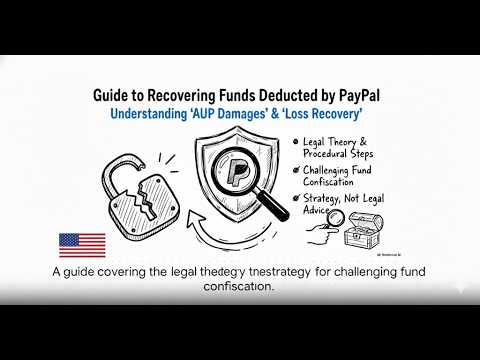
Slide version (summary)

This deck is a visual summary of the main points in this guide. The full, detailed, and legally-developed version is the text guide below on this same page.

⚠️ PayPal’s AUP seizures and UDAAP: a regulatory risk analysis

This section is written as a regulatory and compliance risk analysis, not as a court finding. It explains why PayPal’s recurring practice of converting customer balances into so‑called “AUP damages” creates serious exposure under U.S. consumer financial protection law and why regulators, compliance teams, and arbitrators would reasonably scrutinize it.

In the United States, payment platforms and fintechs are subject to the Consumer Financial Protection Act (12 U.S.C. §§ 5531–5536) and to the prohibition on Unfair, Deceptive, or Abusive Acts or Practices (UDAAP). A practice can be unlawful even if a contract purports to allow it, if in operation it causes substantial consumer harm, misleads users, or takes unreasonable advantage of their inability to protect their interests.

What follows is not rhetoric. It is a plain‑English mapping between PayPal’s documented AUP “damages” workflow and the three UDAAP categories that U.S. regulators and arbitrators actually apply. The analysis is based on the mechanics repeatedly reported by users: account limitation, a long “hold” framed as temporary, and a later permanent conversion of the balance into PayPal’s own funds without any itemized loss calculation.

1) Why regulators would view this as Unfair

A practice is typically considered unfair if it causes substantial consumer injury, the consumer cannot reasonably avoid it, and the injury is not outweighed by countervailing benefits.

  • Users routinely lose thousands or tens of thousands of dollars in one automated balance sweep.
  • Once an account is limited, the user has no practical way to move, hedge, or protect those funds.
  • No transaction‑level loss, chargeback total, or cost breakdown is shown to justify the amount taken.

From a regulatory perspective, this looks like substantial, unavoidable financial harm imposed by a dominant platform through a mechanical process, with no demonstrated compensating benefit to the affected user and no individualized assessment of loss.

2) Why regulators would view this as Deceptive

A practice is generally considered deceptive if it is likely to mislead a reasonable consumer about a material fact.

  • PayPal communications commonly describe the initial limitation as a temporary hold.
  • Users are often told that funds will be released after 180 days if no issues remain.
  • Later, the same funds are re‑characterized and permanently taken as “damages” or “loss recovery” without any disclosed loss calculation.

Framing a hold as temporary and customer‑owned, and then converting it into a permanent confiscation without a transparent, itemized loss explanation, is exactly the kind of switch in economic reality that consumer protection law treats as materially misleading.

3) Why regulators would view this as Abusive

A practice is commonly characterized as abusive when a company takes unreasonable advantage of the consumer’s inability to protect their interests or of the company’s control over critical resources.

  • PayPal has unilateral technical control over the account and the funds.
  • The user cannot audit, escrow, or independently safeguard the balance during the limitation period.
  • The user has no meaningful ability to negotiate, contest, or even verify the basis of the amount taken.

In regulatory terms, this resembles the use of platform control over captive customer funds to impose a one‑sided economic outcome that the customer cannot realistically resist or mitigate.

Why this matters beyond contract law

Even if a contract contains a “liquidated damages” label, U.S. law and UDAAP principles focus on how the practice works in reality. A mechanism that functions as a penalty, is applied automatically, and is not tied to demonstrated loss can attract scrutiny as a consumer financial protection issue, not just a private contract dispute.

This is the same analytical framework regulators use when they require banks and fintechs to change practices and return money to customers through remediation programs. The purpose here is to show why PayPal’s AUP “damages” system fits squarely within that risk profile.

Focused on liquidated damages and lack of proof. Written so a normal person can follow it step by step.

This guide helps users recover their funds after a PayPal permanent limitation in the United States by documenting the post-180-day deduction process and showing how JAMS or AAA arbitration is used to challenge AUP damages.

Target: AAA Consumer Arbitration
Key concept: unenforceable penalty

Scope of use: The arguments and templates in this guide are designed to be used in mediation, consumer arbitration (AAA/JAMS), regulatory complaints (e.g., CFPB / State AG), and, where applicable, court litigation. The core theory (unenforceable penalty / lack of proof of damages) is the same across these forums; only the procedure changes.

This guide is for general informational purposes only and does not constitute legal advice. Every case depends on its specific facts, evidence, and jurisdiction.

On this page
0%