Documented PayPal Loss Recovery and AUP Damages Cases
A curated set of real-world examples showing how PayPal "AUP damages", "loss recovery", and permanent limitations can lead to large balance deductions, refusals to disclose alleged violations, and support promises that later conflict with outcomes. Each item below includes a short explanation and the underlying screenshot or source.
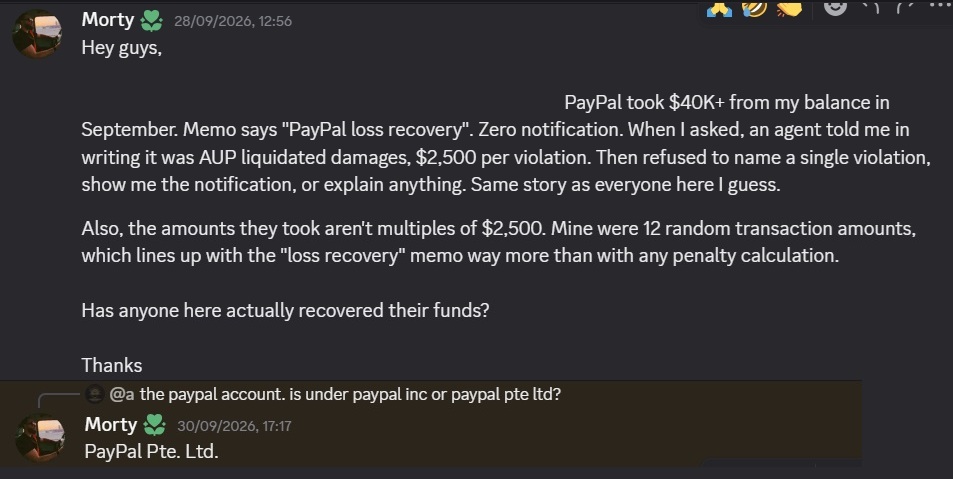
User with a PayPal Pte. Ltd. merchant account reports $40K+ balance deduction in September 2026
Posted by a user ("Morty") describing a PayPal Pte. Ltd. merchant account. PayPal took over $40,000 from the balance in September 2026, with the transaction memo reading "PayPal loss recovery" and no prior notification. When the user asked, a PayPal agent confirmed in writing that it was AUP liquidated damages calculated at $2,500 per violation, then refused to name a single violation, show the notification, or explain anything further.
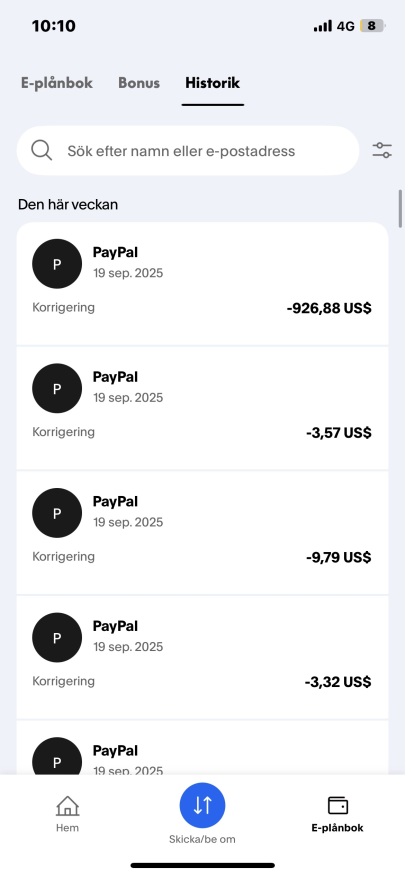
2025: AUP deduction applied to Swedish graphic design freelancer, 2 years after PayPal removed the penalty clause in Europe
A Swedish user who sold graphic design services had his account suspended with no explanation. PayPal then applied multiple “Korrigering” (correction) deductions on 19 September 2025, including one for USD 926.88. No policy violation was identified and no loss calculation was provided. PayPal claims the user bought cryptocurrency but didn't cause any harm, loss or damage to them.
Notable because PayPal removed the explicit USD 2,500 per-infraction penalty clause in June 2023, leading many to believe the practice had ended. This case shows deductions continued into 2025 under a different label.
In memoriam: "angrykitten" († May 2026)
A user affected by PayPal's AUP penalty system died by suicide last week.
The user known as "angrykitten" sold gym supplements through PayPal. In 2022, his entire balance was swept under the AUP damages mechanism, with no explanation, no proof of damages, and no identified violation. He had debts. He had depression. From 2022 onward, his posts reflected increasing financial and emotional strain. He wrote about debt, about depression, and about the PayPal situation. We do not know everything that was happening in his life, and we are not in a position to assign cause. What we can document is the sequence: the balance sweep happened in 2022, and his writing changed after that. In his final months, he had largely disappeared from the communities he used to frequent. He was not connecting to Steam. In May 2026, he died by suicide.
PayPal never provided proof of what harm his supplement business caused them.
This was brought to one of this website's administrators by his sister. We have her permission to share it.

If you are struggling, please reach out.
We have a dedicated section on financial trauma that may help. Reading that other users are going through the same situation makes it a little easier: you are not alone in this.
Financial loss is devastating, but it is not the end of the road. Help is available.
- USA: 988 Suicide and Crisis Lifeline, call or text 988 (free, 24/7)
- UK: Samaritans, call 116 123 (free, 24/7)
- Singapore: Samaritans of Singapore, call 1-767 (free, 24/7)
- Europe: Samaritans, call 116 123 (available in several European countries, free, 24/7). For other countries, visit findahelpline.com to find your local line.
Reddit report, March 2026: PayPal empties $7,500 balance days before 180-day hold expires
Posted to r/paypal in March 2026. The user had USD 7,500 in a business account, days away from the end of the 180-day hold. PayPal sent an email about recovering losses from restricted activities, and when the user logged in the balance was zero: two transfers had been made to PayPal with no itemised calculation and no prior notice.
Included as evidence that the fund-removal practice remains active.

Animal shelter reported as having $11k taken as “damages”
Local news report describing PayPal taking $11,000 from a county SPCA account as "damages". Source: Shenandoah Sentinel. Read the article.

Why these deductions may not match a loss calculation
Across the cases documented below, deductions are often triggered by an alleged AUP issue and applied as a fixed or balance-matching sweep, without a transaction-level explanation of any quantified loss.
- Trigger: the deduction follows an alleged policy issue, not a priced service or an identified third-party claim.
- Quantum: the amount often mirrors the available balance or a preset figure, rather than a loss calculation tied to specific events.
- Disclosure: PayPal does not provide transaction-level loss particulars or a verifiable methodology linking the amount to causation and quantum.
- Decision basis: in some cases, the limitation decision may be influenced by automated risk systems; clear transaction-level particulars are therefore necessary to verify the basis and avoid false positives.
Taken together, these features are commonly associated with punitive or deterrent charges rather than compensatory damages.
"The money belongs to you" while still withheld
This screenshot is about my case. Read details about my personal case with paypal here.
Screenshot of a PayPal communication sent to one of this site’s administrators. In the same message, PayPal explicitly states: "The money belongs to you but is held in reserve to cover any disputes or reversals that your customers may file against you." Despite acknowledging in writing that the funds belong to her, PayPal continues to refuse to release the money. In this case, the account never had any disputes or reversals, yet the funds are still not returned.
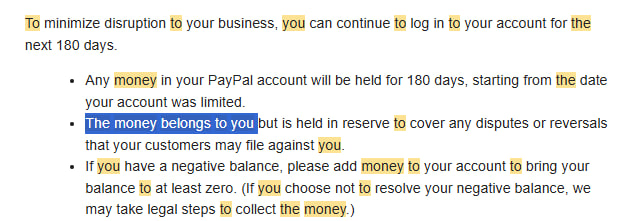
Why is this email so important?
This PayPal email was sent in response to my inquiry asking PayPal to identify what specific policy or Terms provisions were allegedly violated. In that same written reply, PayPal stated "The money belongs to you" while still withholding the funds.
In Singapore, a written acknowledgment of a debt or other liquidated pecuniary claim can cause a fresh accrual of the limitation period from the date of acknowledgment.
Illustrative example: That is why an acknowledgment made in 2025 can be relevant to a limitation timeline that otherwise pointed to 2026, potentially moving it to 2031.
Silence and evasiveness after acknowledgment
After sending this acknowledgment, PayPal then shifted into stonewalling: relying on technicalities, avoiding the core factual questions, and refusing to give a straightforward, transaction-level explanation. That kind of post-acknowledgment silence and evasiveness can be relevant evidence of bad faith when assessed by a regulator or a tribunal, because it suggests a deliberate strategy to delay and frustrate accountability rather than address the merits.
🎧 Brief explanation of "loss recovery" / AUP Damages deductions
What does it really mean when PayPal labels a deduction as "loss recovery"? This short NotebookLM audio explains how the mechanism works and why transaction-level losses are often not disclosed.
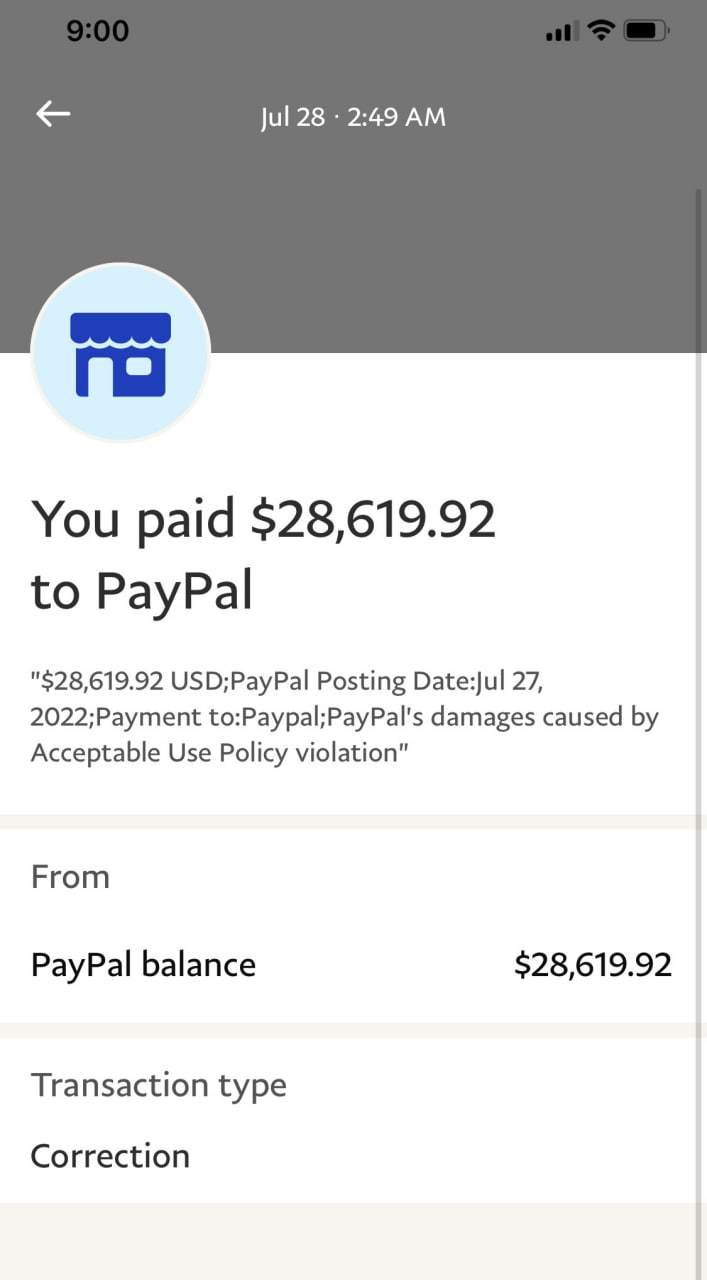
Balance wipe labelled as "AUP damages" (USD 28,619.92)
Screenshot showing a USD 28,619.92 deduction described as "PayPal's damages caused by Acceptable Use Policy violation", taken directly from the PayPal balance. This pattern is often described as a "balance sweep" because the amount mirrors the available balance rather than any disclosed loss calculation. This is characteristic of a penalty-style forfeiture, not of a compensatory damages calculation.
Refusal to disclose the basis of the review
PayPal acknowledges that a review occurred but refuses to provide the underlying particulars. Without transaction-level details, customers cannot test or rebut the factual basis of an enforcement action.

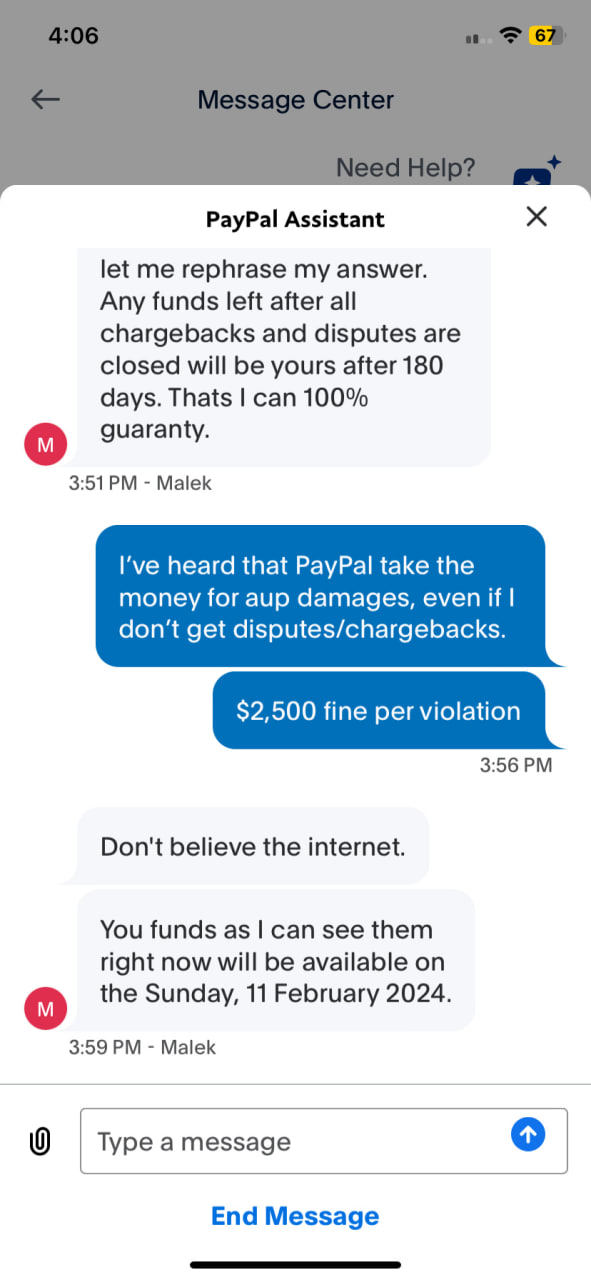
Support promise: "Any funds left after 180 days will be yours"
Support message promising funds will be available after 180 days once chargebacks/disputes are closed. In the reported case tied to this screenshot, instead of releasing the balance, PayPal wiped the entire balance roughly one week before the 180-day deadline. No loss calculation, transaction-level particulars, or proof of damage was provided to justify a full balance wipe.
Mainstream coverage: funds withheld with no proven loss
TheGamer reported allegations that PayPal withheld £80,000 linked to an adult Steam game. Cases like this matter because the funds are often retained or deducted without PayPal proving any specific loss or damage tied to the amount withheld.

Multi-currency wipe: funds taken across USD, GBP, and EUR
Account history showing multiple transfers to PayPal in different currencies (USD, GBP, EUR) on the same day. This looks like a sweep of whatever liquidity exists across currencies, which is consistent with a penalty-style forfeiture, not with any genuine loss assessment.

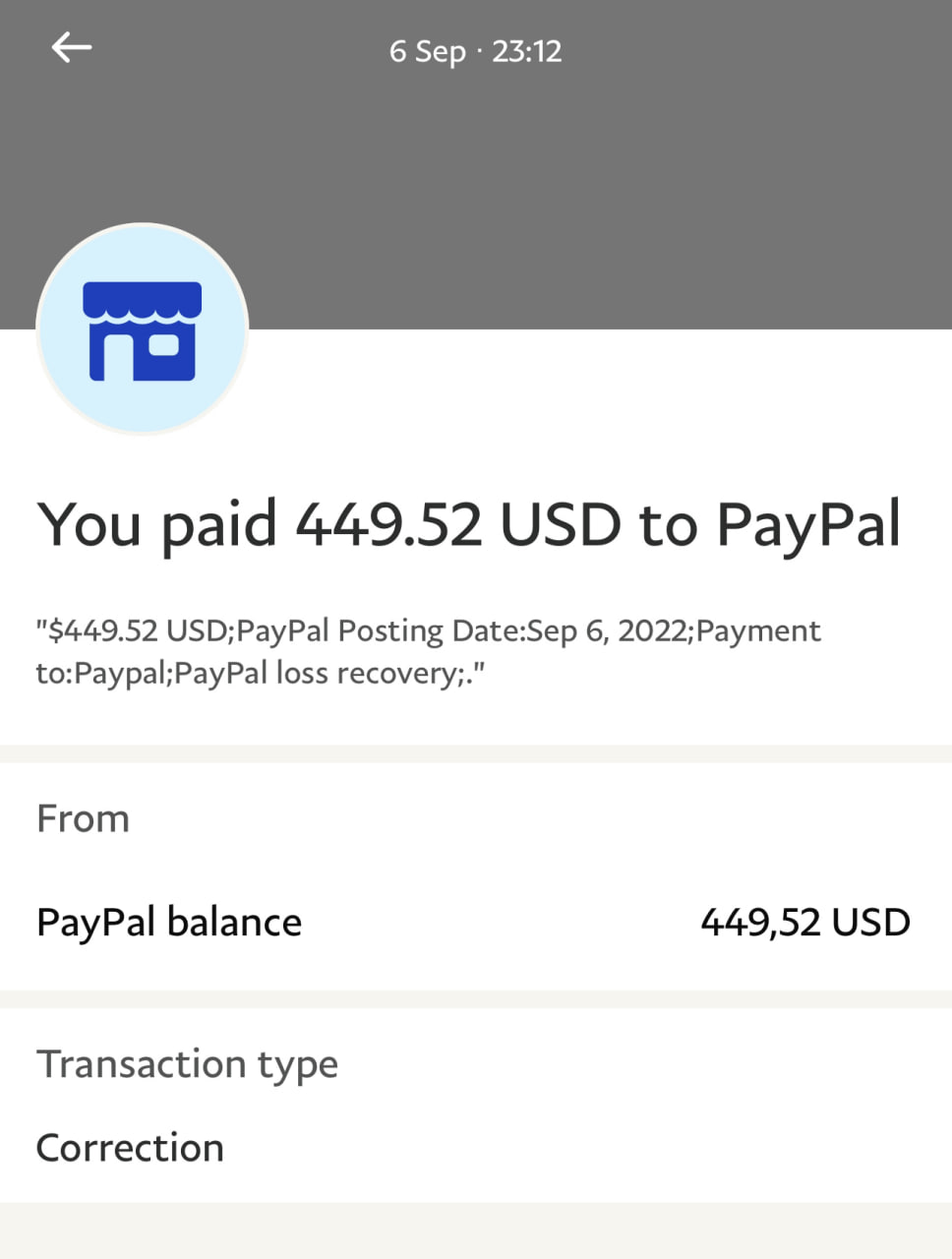
"Loss recovery" label replaces "damages" (USD 449.52)
Screenshot showing a USD 449.52 deduction labelled "PayPal loss recovery" (posting date: 6 Sep 2022). Possible reason: "loss recovery" reads like reimbursement of a specific loss, while "damages" invites scrutiny about whether any loss was calculated, proven, or independently determined. The practical issue remains the same when no transaction-level particulars are disclosed.
Legal significance of these examples
Taken together, these cases show a consistent enforcement pattern:
- Funds are taken without proving any concrete loss.
- The amount taken often tracks the account balance, not any alleged damage.
- The deduction is automatic once an AUP violation is asserted.
This is exactly how penalty clauses operate in practice: they punish and deter, rather than compensate. Under penalty doctrine and unfair terms frameworks in multiple jurisdictions (UK, EU, Singapore), mechanisms with this structure are legally vulnerable, regardless of how they are labeled.
Want to add a story
If you have a screenshot showing an "AUP damages" deduction, a balance going to zero, a multi-currency sweep, or a refusal to provide particulars, send your documentation to