Financial Trauma: The Psychological Impact of Losing All Your Money Without Explanation
What happens to your brain and mental health when funds are taken without explanation, and why the damage does not end on the day of the debit.
By Kanya Jaidee
If you just discovered a PayPal AUP deduction or Loss Recovery entry in your account, you are probably in shock right now. That is a normal neurological response to sudden, unexplained financial loss. This page explains what is happening to you and why, and what you can do about it. The legal guides are available here when you are ready.
The initial shock
There is no warning. No phone call. No email in advance. You open your account and the money is gone. Not some of it. All of it. Replaced by a single line of text: "PayPal's damages caused by Acceptable Use Policy violation." Or sometimes just "Loss Recovery." The label is opaque. The amount is exact. The explanation is absent.
The first instinct is to assume it is an error. You refresh. You log out and back in. You check again. Nothing changes. The brain struggles to accept what it is seeing because nothing in the prior relationship prepared you for this. No process led here. No conversation happened. One day the money was there. Then it was not.
The amygdala, which processes threat responses, activates immediately upon perceiving sudden financial loss. The prefrontal cortex, responsible for rational planning and decision-making, partially disengages. This is the same neurological response triggered by physical threats. The result is a state of acute stress in which clear thinking is temporarily impaired: the first hours after discovering the deduction are typically the worst time to make decisions about how to respond.
Research on financial loss and brain function (Kahneman, Tversky; Thaler) consistently shows that losses are processed with roughly twice the emotional intensity of equivalent gains. Losing USD 5,000 produces approximately twice the psychological impact of gaining USD 5,000. A sudden, unexplained seizure of an entire account balance amplifies this effect because there is no reference point, no negotiation, and no preparation.
User report, auprecovery.com community
Financial trauma
The research literature on financial trauma (Klontz, Lawson, Shapiro) distinguishes between ordinary financial stress, which is persistent but manageable, and financial trauma, which is a response to a sudden, severe, and unexpected financial event that overwhelms the person's ability to cope. A PayPal AUP deduction frequently falls into the second category, particularly when it represents a significant proportion of savings, operating capital, or income.
Symptoms that resemble PTSD
Clinically documented responses to financial trauma include symptoms that parallel post-traumatic stress disorder. These are not metaphors. They are recognised responses to a category of event that researchers classify as a traumatic stressor:
Repeated involuntary mental replaying of the moment of discovery. Difficulty concentrating on unrelated tasks. Waking at night thinking about the loss or what could have been done differently.
Compulsive checking of other financial accounts. Inability to trust payment processors or banking platforms. Disproportionate anxiety about unrelated financial transactions.
Avoiding opening financial apps or emails. Putting off necessary financial decisions because the subject triggers distress. Withdrawing from conversations about money with family or partners.
Disproportionate self-criticism about having used PayPal, about the nature of the activity that triggered the limitation, or about not having "seen it coming." This is particularly common when the user knows they were operating in a grey area, but it also affects users whose activity was entirely lawful.
Important: these responses are normal reactions to an abnormal event. They are not signs of weakness or instability. They are the predictable consequence of having money taken without explanation by an institution you trusted.
Institutional betrayal
Research by Smith and Freyd (2014) identifies a specific category of psychological injury called institutional betrayal. This occurs when an institution upon which a person depends for safety or essential services acts in a way that causes harm, or fails to protect them from harm. The concept was developed initially in the context of universities and healthcare, but it applies with precision to regulated financial institutions.
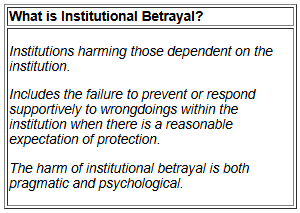
Source: Freyd, University of Oregon
The damage from a PayPal AUP deduction is not just the financial loss. It is the fact that the entity that caused the harm is a licensed payment institution, operating under regulatory frameworks specifically designed to protect users. PayPal is not an anonymous scammer. It is a regulated Major Payment Institution. The expectation of custodial safety is not naive: it is exactly what financial regulation is supposed to guarantee.
When the institution that was supposed to hold your funds safely is the same institution that took them without explanation, the psychological damage is compounded by the destruction of the trust that made the relationship possible in the first place. This is what makes institutional betrayal distinct from ordinary fraud or theft: the perpetrator was also the protector.
This betrayal is not merely moral. Under Singapore's Payment Services Act 2019, a licensed Major Payment Institution has a statutory duty to safeguard relevant funds held on behalf of customers. That duty exists precisely because customers are entitled to rely on the institution as a custodian, not merely as a counterparty. When the same institution that holds that duty is the one that appropriates the funds without documented justification, the psychological experience of betrayal maps directly onto a regulatory failure. The trust that was broken was not naive: it was legally mandated.
In some cases, the betrayal is twofold. PayPal operates under a licence granted by the Monetary Authority of Singapore. Where MAS has not intervened to prevent the seizure of relevant funds or to enforce compliance with its own Fair Dealing Guidelines, the affected user has been failed not by one institution but by two.
How this reshapes behaviour permanently
The consequences extend well beyond the dispute itself. Many users report abandoning payment processors entirely after an AUP deduction, regardless of whether the funds were eventually recovered. A recurring pattern is never again allowing significant balances to accumulate in any single digital account: funds are moved out immediately after receipt, balances kept near zero. And once a regulated institution has taken money without explanation, the implicit safety of other regulated institutions is no longer assumed. The belief that "this cannot happen to me" has already been disproved. What remains is a persistent awareness that it can happen again, from any direction, at any time. That awareness does not disappear when the case resolves. Beyond behaviour, it changes how you see yourself: as someone who was in control of your financial life, until you realised you were not.
The injustice dimension
What makes a PayPal AUP deduction psychologically distinct from other financial losses is not just the money. It is the combination of the financial loss with a complete absence of process. Research on procedural justice consistently shows that people's psychological response to adverse outcomes is heavily influenced by whether they perceive the process as fair, not just the outcome itself.
Procedural vs. outcome fairness
In one of the most replicated findings in social psychology, Lind and Tyler (1988) showed that people accept worse outcomes when they feel the process was fair, and respond much more negatively to moderate adverse outcomes when the process was perceived as unfair. The key elements of procedural fairness are: voice (the ability to be heard), neutrality (an impartial decision-maker), and respectful treatment.
A PayPal AUP deduction violates all three simultaneously. There is no prior notice. There is no hearing. There is no impartial reviewer. There is no itemised explanation of what was lost. There is no opportunity to respond before the money is taken. The combination of a bad outcome with a maximally opaque and unilateral process produces a psychological response that is significantly more distressing than the financial loss alone would generate.
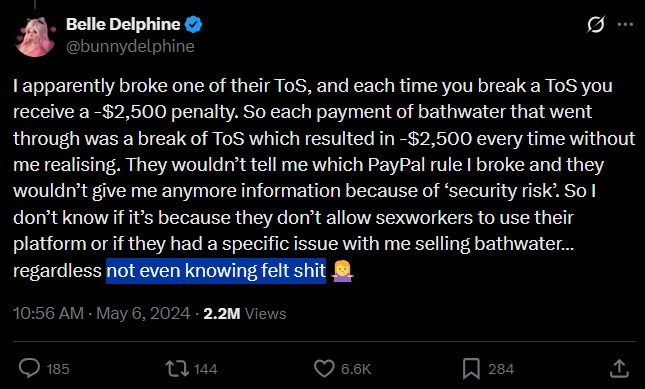
The opaqueness is not incidental. When PayPal refuses to specify which rule was violated, users are left in a state that researchers describe as ambiguous threat: the punishment is real and concrete, but the violation remains undefined. This is psychologically more destabilising than being told you did something wrong, because it makes it impossible to contest, appeal, or even process. You cannot defend yourself against a charge you are not allowed to know.

User report, auprecovery.com community
The cost of unresolved time
A single acute financial loss, even a large one, is psychologically manageable for most people. The brain can process a defined event, grieve it, and begin to adapt. What is much harder to process is a loss that remains unresolved for months or years: a situation in which the money is gone but the case is still open, still unresolved, and still requiring active attention.
Chronic financial anxiety
Research on unresolved legal and financial disputes (Kritzer, 2004; Sandefur, 2007) documents a consistent pattern of elevated chronic anxiety in people with ongoing disputes, particularly when the other party is a large institution. The psychological burden is compounded by several factors specific to PayPal AUP cases:
Mullainathan and Shafir (2013) documented that financial scarcity and unresolved uncertainty consume cognitive bandwidth, the mental capacity available for thinking, planning, and decision-making. An unresolved PayPal dispute actively occupies working memory, reduces the quality of decisions made in other areas of life, and generates what the researchers call a cognitive tax. The 180-day hold period alone, with its combination of false hope and uncertainty, is a documented form of this drain.
The affected user is a private individual. The institution is a multinational corporation with legal teams, PR departments, and external counsel. The psychological weight of fighting an entity with vastly greater resources is documented as a specific form of institutional stress.
Unlike a theft, where the loss is definite, or a court case, where there is a defined endpoint, an unresolved PayPal dispute exists in permanent ambiguity. The money might come back. It might not. Planning around this uncertainty is cognitively exhausting.
Each email to PayPal that goes unanswered, each new explanation that shifts the stated reason, each regulatory complaint that does not resolve the case, reactivates the original stress response. Users in multi-year disputes describe not a gradual reduction in distress but a pattern of intermittent acute stress episodes overlaid on a persistent background anxiety.
Extended financial disputes are consistently associated with disrupted sleep, reduced productivity, and impaired interpersonal relationships. The person is never fully "off" the problem because it is unresolved and the stakes are real.
The solitude of the process
Most affected users do not tell anyone what happened to them, at least not initially. The reasons vary: embarrassment about having used PayPal for certain types of transactions, not wanting to worry family members, uncertainty about how to explain a situation that sounds implausible, and fear of being told it was their own fault.
This solitude significantly amplifies the psychological impact. Psychological research on social support and stress (Cohen and Wills, 1985) is unambiguous: having a community of people who understand your situation is one of the strongest buffers against the mental health effects of adverse events. The isolation that accompanies most PayPal AUP disputes removes that buffer entirely. Belle Delphine, a creator with 2 million followers, kept her PayPal situation secret for five years. If she felt she could not tell anyone, it is understandable that you feel the same. This is systemic, not personal.
Paths to recovery
Psychological recovery from financial trauma does not require recovering the money, though recovering the money helps. It requires several things that are within reach regardless of how the legal case resolves:
The deduction mechanism PayPal uses is legally contested across multiple jurisdictions. At least one arbitrator in the US has described this type of clause as a penalty that may not be enforceable when challenged. The fact that PayPal took your money does not mean you did something wrong. It means PayPal applied a clause that it cannot justify when examined on the merits.
Knowing that other people are in the same situation, fighting the same institution, using the same arguments, changes the psychological experience fundamentally. There are Discord groups of users affected by these deductions where people share experiences, strategies, and support. This site exists in part because of that community. The user cases and success stories are not just legal resources. They are evidence that you are not alone.
One of the most consistent findings in stress research is that perceived control reduces anxiety even when actual control is limited. Having a clear plan of action, knowing which regulatory body to approach, knowing what arguments are available, and knowing what other people have done in the same situation, restores a sense of agency. That is what the guides on this site are designed to provide.
Open-ended disputes are psychologically the most damaging. Setting a defined timeline for your next steps, and committing to a decision point at which you either escalate or accept closure, is healthier than indefinite waiting. It does not mean giving up. It means taking control of the timeline rather than leaving it entirely in PayPal's hands.
If the impact of the dispute is significantly affecting your daily functioning, sleep, relationships, or mental health, speaking to a mental health professional is not an overreaction. Financial trauma is a recognised category of psychological distress. It is treatable. The dispute and the psychological recovery from it do not have to proceed on the same timeline.
Legal systems in multiple jurisdictions already recognise this type of harm. Courts have awarded damages for distress and loss of financial security in contractual contexts where protection of funds was the core purpose. Civil law countries including France, Germany, and Spain recognise equivalent moral damages. Consequential damages, covering loss of business opportunity, costs incurred during the dispute, and impaired decision-making documented by bandwidth poverty research, are claimable separately from the principal in several jurisdictions. In the right forum, the harm described on this page is not abstract: it is identifiable, arguable, and compensable.
You are not alone
The pattern documented on this site, account limitation, 180-day hold, unilateral balance sweep with no proof of loss, has affected hundreds of users across multiple countries and jurisdictions. The legal arguments against it are strong. The regulatory pressure is growing. Courts and arbitrators in the US, UK, and Europe have all raised questions about the clause's validity when it was actually examined.
The money may or may not come back. But the feeling of powerlessness that a PayPal AUP deduction generates is not accurate. There are real legal avenues, real regulatory bodies, and real people who have recovered their funds. The guides on this site are the starting point.
Choose your jurisdiction for a step-by-step guide: UK, USA, Europe, or Singapore and Latin America. If you want to share your case or read others, see User Cases, or contact us at aupdamages(at)gmail.com to share your story directly.
If you want to read further
These books and resources directly inform the research cited on this page and are accessible to non-specialist readers:
- Klontz & Klontz, "Mind Over Money" (2009): the foundational text on financial trauma and how financial events reshape long-term behaviour.
- Mullainathan & Shafir, "Scarcity" (2013): the source of the bandwidth poverty concept applied to unresolved financial disputes.
- Kahneman, "Thinking, Fast and Slow" (2011): the reference work on loss aversion and how the brain processes financial loss at roughly twice the intensity of equivalent gains.
- Housel, "The Psychology of Money" (2020): the most accessible entry point to behavioral finance and financial decision-making under stress.
- Freyd, "Institutional Betrayal and Institutional Courage" (paper, freely available): the original research on institutional betrayal as a specific category of psychological injury, directly applicable to regulated financial institutions.